
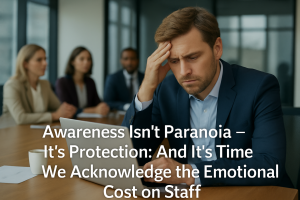
Awareness Isn’t Paranoia — It’s Protection: And It’s Time We Acknowledge the Emotional Cost on Staff
Every week I sit with people who tell me the same thing in different ways:
“I don’t feel safe at work anymore.”
It’s NHS receptionists dealing with verbal abuse at 8:30am.
Hospitality staff managing unpredictable behaviour.
Security teams stretched thin in environments that feel more volatile by the month.
We talk a lot about procedures, systems, and policies… but not enough about the person absorbing the impact of each incident.
The truth is simple:
When people don’t feel safe, they can’t perform at their best. They shrink. They anticipate the next confrontation. They take that tension home.
And this is exactly where situational awareness becomes more than a “security skill.”
It becomes a wellbeing tool.
Situational awareness isn’t about paranoia, fear, or seeing every member of the public as a threat.
It’s about giving staff — in any sector — the ability to:
-
Read their environment
-
Sense changes early
-
Understand behaviour patterns
-
Know when to step forward
-
Know when to step back
-
Make calm decisions under pressure
When people feel prepared, they feel safe.
And when they feel safe, the emotional load drops dramatically.
I’ve seen it dozens of times.
A team goes from anxious to confident with nothing more than guidance, some simple principles, and a chance to practise. You can see the shift in their shoulders… the room relaxes… the conversations change.
Because awareness creates control.
Control creates confidence.
And confidence protects people — emotionally and physically.
As incidents continue to rise across healthcare, transport, retail, hospitality, and even community spaces, organisations need to focus less on posters and more on people.
Staff don’t need slogans.
They need skills.
They need support.
And they need leaders who recognise that safety isn’t just operational — it’s deeply human.
If your teams are feeling the pressure, there are practical steps that make a real difference.
The kind that stay with people long after the training day has ended.
If you’d like to talk about strengthening your team’s confidence and awareness, I’m always happy to share what works.
#WorkplaceSafety #SituationalAwareness #StaffWellbeing #NHSPrimaryCare #HealthcareSafety #HospitalitySafety #SaferWorkingEnvironments #ConflictManagement #Deescalation #RiskManagement #SecurityTraining #EmployeeSupport #FrontlineStaff #ZeroTolerance #ProtectingPeople
Recent Comments