
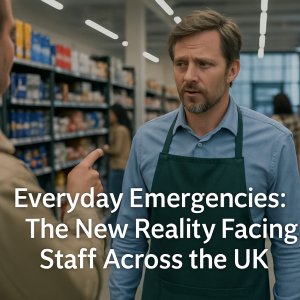
Most people imagine emergencies as big, dramatic events — blue lights, major incidents, headlines.
But the truth is far quieter, far more frequent, and affecting far more people than we usually acknowledge.
We’re living in an era of everyday emergencies.
They happen on trains, in GP surgeries, in hospitality, in reception areas, on the street, in shops, and inside organisations that never used to think of themselves as “high risk.”
And it’s taking a toll.
Over the past year, I’ve spoken with NHS receptionists who start their morning dealing with verbal abuse before they’ve even logged in.
Hospitality staff managing unpredictable behaviour.
Transport staff facing rising aggression.
Corporate teams feeling tension in places that used to feel safe.
These aren’t isolated incidents.
They’re becoming part of the working landscape.
And here’s the uncomfortable truth:
Most frontline staff have never been given the tools to deal with this.
🔶 The gap is growing
Workplaces have policies, slogans, email reminders, and “Zero Tolerance” posters — but very few have given their people the skills and confidence to recognise early warning signs, manage behaviour, and protect themselves emotionally and physically.
If you don’t teach people how to stay safe, they default to:
-
freezing
-
hoping someone else steps in
-
reacting too late
-
absorbing the emotional impact long after the incident ends
Confidence is replaced by anxiety.
Awareness becomes fear.
And staff performance drops, not because they can’t do the job — but because they don’t feel safe doing it.
🔶 Why “everyday emergencies” matter
Not because every incident is life-threatening.
But because the accumulation of small, unpredictable events chips away at people.
The receptionist who braces herself each morning.
The manager who dreads certain customers.
The staff member who goes home replaying the moment they didn’t know what to do.
This is where organisational responsibility becomes absolutely critical.
🔶 Skills change everything
I’ve spent decades responding to real emergencies — from the Fire Service to media security, OB operations and corporate advisory roles. And I’ve seen one thing proven again and again:
Incidents don’t escalate because staff are weak.
They escalate because staff are unprepared.
When people learn even the basics of:
-
situational awareness
-
recognising behaviour patterns
-
de-escalation
-
early decision-making
-
confidence under pressure
-
safe disengagement
…the whole environment changes.
You can feel the energy shift.
People become more grounded, more alert, more capable.
They carry themselves differently.
And most importantly:
they don’t feel alone anymore.
🔶 The way forward
We need to stop pretending that incidents are “rare” or “unusual.”
They’re not. And staff know this.
Organisations need to move from policy-driven safety to people-driven safety.
That means:
🔸 Real training
🔸 Real support
🔸 Real conversations
🔸 Real awareness
🔸 Real leadership
Because everyday emergencies don’t go away on their own — but we can absolutely equip people to handle them.
If your teams are feeling the pressure, or you’re seeing signs of strain, I’m always happy to talk through practical steps that genuinely make a difference.
Safety isn’t just operational.
It’s human.
And it starts with giving people back their confidence.
#WorkplaceSafety #EverydayEmergencies #SituationalAwareness #StaffWellbeing #ConflictManagement #Deescalation #NHSPrimaryCare #HealthcareSafety #CorporateSecurity #HospitalitySafety #FrontlineStaff #RiskAdvisory #ProtectingPeople #SaferWorkingEnvironments #ZeroTolerance #SecurityTraining
Recent Comments